
FIRST Components is just about to release a new “damping” headset. We’ll put it in quotes for now because calling this type of headset a damping headset is perhaps not very accurate even as it is the standard practice in the industry.
Let’s then dig deeper into the nitty gritty of damping headsets and then have a close look at FIRST’s new R11A model.
Contents
Damping Headsets: What the Word Actually Means
Damping, in relation to bike headsets, has become a common term that describes the reduction in the degree of freedom of a unit’s lateral movement.
In engineering terms, damping means resistance proportional to velocity: two surfaces move against each other and have a fluid or friction interface between them, resistance that scales with how fast that motion happens.
Several products currently on the market employ the word and concept to different degrees, and for different reasons.
Cane Creek ViscoSet, and now Hellbender 70 Visco
Cane Creek’s version of this technology is the strongest claim to the word “damping” in the category, and it’s had two lives.
The original ViscoSet was shown as a prototype at Eurobike back in 2016 and reached the market not long after; it sits in its own cup pressed into the frame, separate from the standard integrated headset architecture most bikes use.
It was built for a specific, named failure mode: speed wobble. This is the dreaded steering oscillation that starts small and builds through harmonics until it gets dangerous on bikes prone to it under load, cargo bikes and bikepacking rigs mainly.
ViscoSet is now discontinued, replaced by Hellbender 70 Visco, a broader relaunch of the same mechanism into press-fit format (ZS44 top, ZS56 bottom) that fits a wider range of headsets than the old external-cup design.
Cane Creek’s stated market for Hellbender 70 Visco is wider than “heavy bikes” too, covering e-bikes, cargo bikes, commuters, gravel, bikepacking, and, a little unexpectedly, children’s bikes. The target is less experienced riders who are more likely to get caught out by a wobble.
The mechanism in this revamped version hasn’t changed. Micro-thin plates sit interleaved inside the cartridge, half slot-keyed to the stationary cup, half locked to the ring that turns with the steerer, some twelve plates in total, six and six.
A fluorocarbon gel sits between each layer. As the steerer rotates, the plates shear against each other through that gel, generating resistance proportional to how fast the steering moves. In other words, textbook viscous damping.
It’s also tuneable. Rotating the shims changes the damping characteristic from barely-there to firm. Not a feature you’d bother building unless the physics actually behaved like a damper across a range, not just a fixed friction point at one setting.
FSA/Lauf Honey Bearing
FSA’s version sits under the Orbit line: MR215 for the 1-1/8″ upper, MR170 for the 1.5″ lower, developed with Lauf and announced in August 2023, sold as matched pairs or separately.
The marketing name is Honey Bearing. The functional word FSA uses everywhere else is “damping”, unhedged.
The mechanism works differently to ViscoSet, and it’s less mechanically transparent.
FSA won’t confirm what’s under the seal.” But Lauf’s own installation notes gives some hints.
Fitting the upper bearing means tightening the top cap to roughly 5Nm before the stem bolts go on, because that torque pushes the bearing up against the head tube and generates the friction the damping depends on.
So the resistance isn’t purely sealed inside the bearing. It’s at least partly friction between the bearing’s outer race and the head tube itself, an engineered contact interface tuned by how hard you torque the top cap.
Whatever’s inside the seal, grease, elastomer, some viscous compound, is working alongside that external friction, not carrying the effect alone.
FSA and Lauf sell the upper and lower separately so riders can combine them. Their guidance is that the lower bearing provides roughly twice the effect of the upper; stacking both goes from subtle to what testers called overkill. None of the combinations were reported to hurt steering feel, hands on or off the bar.
Does Honey Bearing earn the word “damping”?
Reasonably. It resists ongoing rotational motion while the fork is in motion, which is closer to genuine damping than a static element that just sits under load.
But nobody’s published a force-velocity curve proving it behaves like a true viscous damper rather than well-tuned dry friction. It’s a defensible claim. It isn’t a rigorously demonstrated one, and unlike Cane Creek, FSA apparently hasn’t put a patent behind it.
One company describes its mechanism down to the plate count and publishes the patent. The other calls it secret sauce and asks you to trust the torque spec.
Two different engineering answers to the same problem
Cane Creek built its mechanism to fight speed wobble, and has carried that same plate-and-gel principle from a standalone external cup into a press-fit design that now fits inside standard integrated headsets.
Honey Bearing was a drop-in replacement for the bearing inside an existing integrated headset from the start, positioned as general buzz reduction rather than a named failure mode. Same word on the box; different starting architecture; different target problem; different level of proof behind the claim.
Let’s then rank them by how earned the word actually is: Hellbender 70 Visco first, genuine viscous shear damping with a named problem, a patent, and adjustable output. Honey Bearing second, friction-based resistance at a moving interface, plausible but less demonstrated, and undocumented internally.
We should mention a third product here too, even though it doesn’t belong in the same ranking, Canyon’s KIS steering stabilization system.
KIS isn’t really damping at all, but rather a spring-based system that recenters the bars after a steering input rather than resisting motion through friction or fluid shear.
The physics is different and it helps to draw a line around what “damping” actually means before the word gets stretched to cover anything that stops a bar from wobbling.
Let’s turn now to look at FIRST’s own damping headset prototype, the R11A.
Looking Inside the R11A
Working through the assembly from top to bottom we have an O-ring, a threadless aluminum top cap sized for 1-1/8″ steerers, a rubber weatherproof cover, then an aluminum collar carried straight over from FIRST’s earlier R10A line rather than built new for this part.
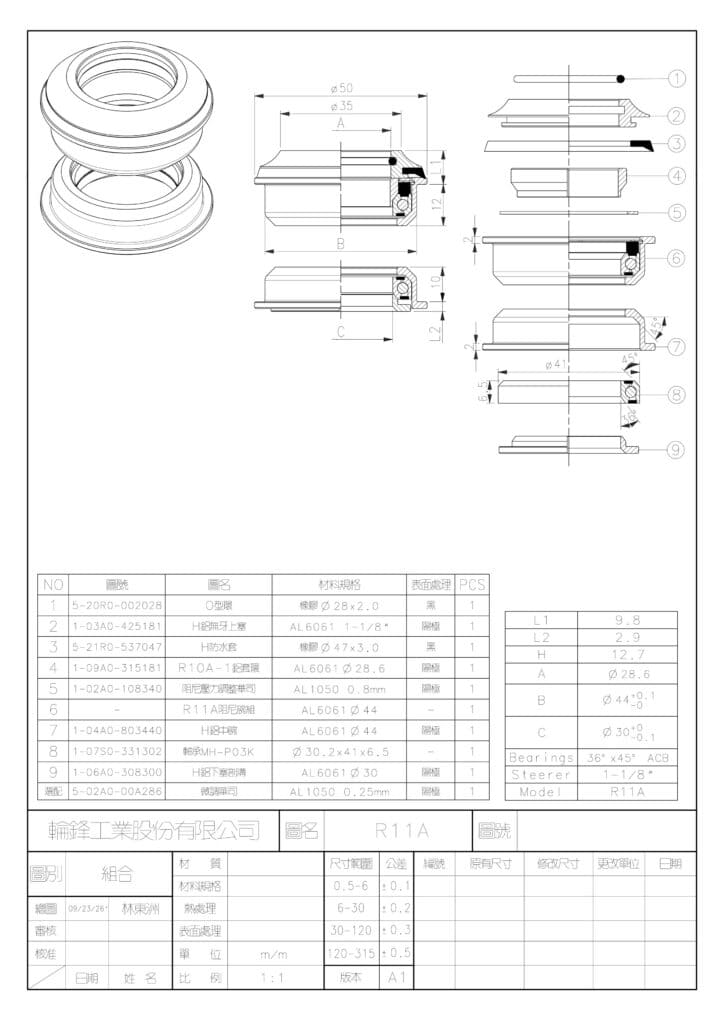
The main elements are two angular-contact bearings which bracket a pair of aluminum middle cups. A slotted aluminum lower plug and a spring-steel C-clip close out the stack, and sitting right against that clip is the 0.8mm aluminum damping pressure adjustment washer, with an optional 0.25mm fine-adjustment washer alongside it.
A C-clip presses against an anodized aluminum spacer.
Nothing in that geometry moves once it’s torqued down. It’s a static stack, compressed once and left there, doing the same job a Belleville washer or a wave washer does in other headset designs, just swapping spring steel for elastomer. The precise engineering term for it is an elastomeric preload spacer.
Installing the R11A damping headset is similar to any other headset: press the Damper Cup Assembly and Lower Cup into the head tube, stack the rest in order, torque down the top cap, stem, bars and locking device. Install the 0.8mm damper shim first.
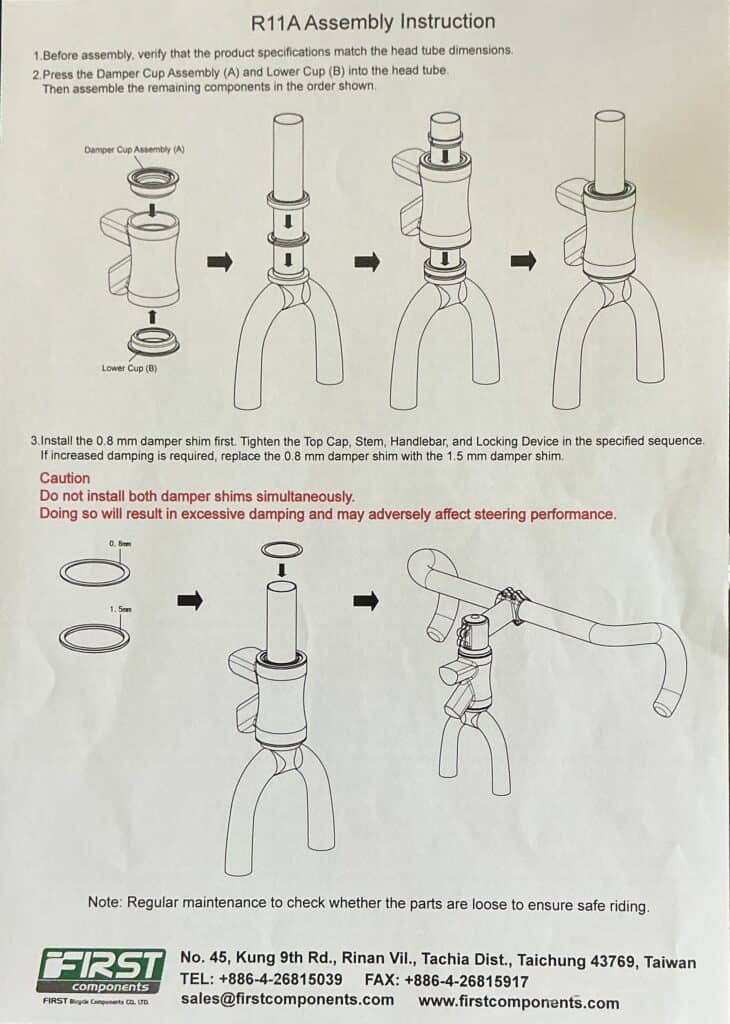
Want more resistance ie. “damping”? Swap it for the 1.5mm shim. Don’t run both at once (the sheet warns in red) or damping gets excessive and steering suffers for it.
In terms of the commentary with which we opened this discussion, the spec puts the R11A at the lower end of the “damper” scale.
Cane Creek’s Hellbender 70 Visco earns the designation of “damping” through actual viscous shear: twelve interleaved plates rotating against each other through a fluorocarbon gel, resistance that scales with how fast the steerer moves.
FSA and Lauf’s Honey Bearing can be classified as “damping” more loosely, friction generated at a moving interface, the bearing race dragging against the head tube under installation torque.
The R11A achieves its elastomeric effect via the spacer, reducing freedom of handlebar movement under load.
It’s set to be released soon.
 EN
 DE